
How does it work?
An analog converter is an electronic circuit that transforms one analog quantity into another analog quantity continuously, without digitization or time slicing.
It acts directly on electrical signals — voltages or currents — to adapt their amplitude, scale, or nature, while maintaining a proportional and instantaneous relationship between the input and output.
Based on components operating in linear mode, such as operational amplifiers, resistors, and passive networks, it is mainly used for conditioning, adapting, and amplifying signals from sensors or intended for analog processing stages.
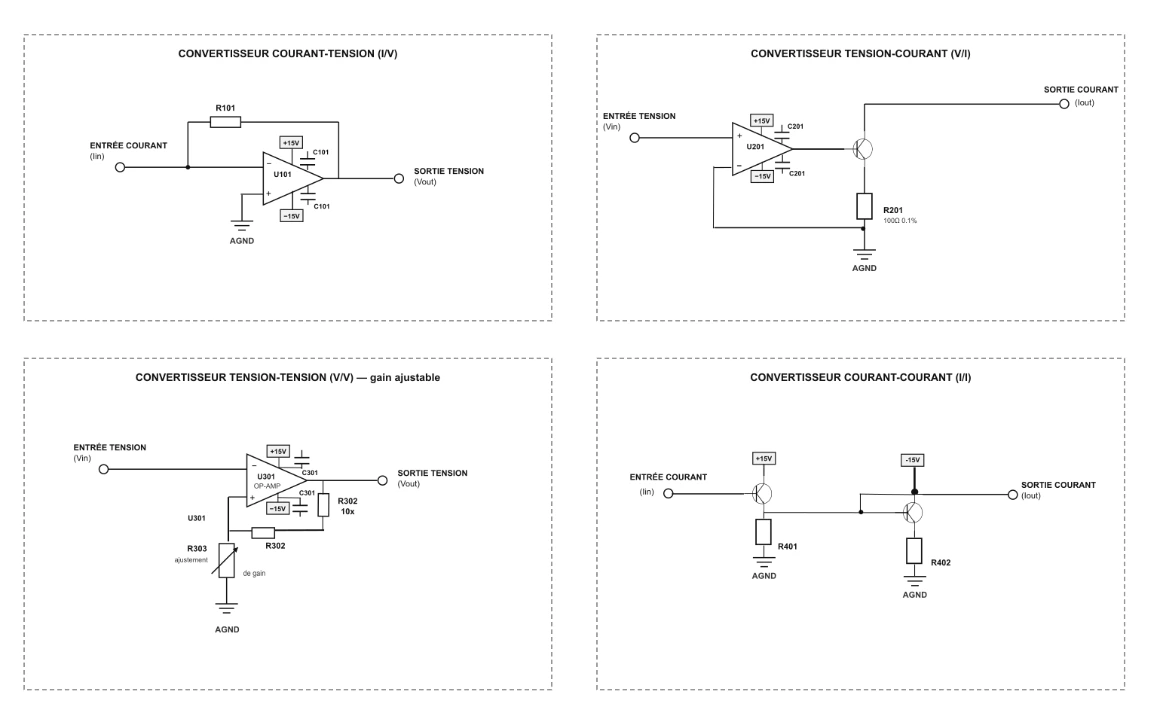
There are several types of analog converters depending on the desired transformation, including voltage-to-voltage converters for level adaptation, voltage-to-current (V/I) and current-to-voltage (I/V) converters widely used in industrial instrumentation, as well as power analog converters like linear regulators.
Each topology is chosen based on constraints of accuracy, noise, bandwidth, and power, with the aim of preserving the integrity of the analog signal throughout the processing chain.
Principle diagram of analog converters

Our range
Analog Signal Converter
Analog Signal Converters
Elecdan designs and manufactures a wide range of analog signal converters.
All the signal converters offered are molded in compact enclosures.
Encapsulated in this way, they are insensitive to dust, humidity, and vibrations.
Offered in several standard versions:
– DIN Rail Mounting (version R)
– Mounting with pins for printed circuit board (version C)
– Assembly with screw terminal and mounting inserts (version P)
Optional (please consult us) :
– Faston terminal (version B)
– Wires (version F)
Below is the list of analog signal converters.
If you do not find the desired function, please consult us to study your request.
Signal converters are classified by input "type" :
- Lines 1 to 23 : voltage
- Lines 24 to 41 : current
- Lines 42 to 44 : resistance
- Lines 45 to 47 : potentiometer
- Lines 48 to 50 : frequencies
- Lines 51 to 54 : temperature
Our products
Reference | Type | Specificity | Input | Output | Technical sheet |
ELII-34A | Current → Current | Triple isolation | 4 - 20 mA | 4 - 20 mA | |
ELII-34V2A | Current → Current | 4-wire mounting | 4 - 20 mA | 4 - 20 mA | |
ELII-31V1A | Current → Current | Self-powered | 0 (4) - 20 (100) mA | 0 (4) - 20 (100) mA | |
ELII-35V1C | Current → Current | Quadruple isolation | 4 - 20 mA | 2 x 4 - 20 mA | |
ELII-35A | Current → Current | Quadruple isolation | 4 - 20 mA | 2 x 4 - 20 mA | |
ELIV-30V1A | Current → Voltage | Self-powered | 0 - 20 mA | 0 - 10 V | |
ELIV-27V2A | Current → Voltage | Self-powered | 0-200 mA | 0 - 10 V | |
ELIV-33V4A | Current → Voltage | Zero noise | 4 - 20 mA | 0 - 10 V | |
ELIV-33V2A | Current → Voltage | Zero noise | 4 - 20 mA | 0 - 10 V | |
ELIV-33V1A | Current → Voltage | Self-powered | 4 - 20 mA | 0 - 10 V | |
ELIV-33A | Current → Voltage | Triple isolation | 4 - 20 mA | 0 - 10 V | |
ELVI-8A | Voltage → Current | Triple isolation | 0 - 10 V | 0 - 20 mA | |
ELVI-9V1A | Voltage → Current | 4-wire mounting | 0 - 10 V | 4 - 20 mA | |
ELVI-22V2A | Voltage → Current | Bipolar | 0 → ± 10 V | 0 → ±i (10 to 80 mA) | |
ELVI-22V1A | Voltage → Current | Bipolar | 0 → ± 10 V | 0 → ± 50 mA | |
ELVI-22A | Voltage → Current | Triple isolation | 0 → ± 10 V | 0 → ± 20 mA | |
ELVI-18 | Voltage → Current | Triple isolation | 0 → ± 100 mV | 0 → ± 20 mA | |
ELVI-9A | Voltage → Current | Triple isolation | 0 - 10 V | 4 - 20 mA | |
ELVV-7A | Voltage → Voltage | Triple isolation | 0 - 10 V | 0 - 10 V | |
ELVV-7V2A | Voltage → Voltage | High frequency | 0 - 10 V | 0 - 10 V | |
ELCT-52A | Temperature | For PT 100 probe | -200° → 600°C | 4 - 20 mA 0 - 10 V | |
ELCT-500B | Temperature | For PT 100 probe | -20° → 150° C | 0.4 - 2 V |