
How does it work?
A linear power supply is an electronic system that converts mains voltage into a stable and reliable direct current voltage, suitable for electronic equipment. It operates through a chain of simple and robust components: a transformer that steps down and isolates the voltage, diodes that rectify the current, capacitors that smooth out variations, and finally a linear regulator that precisely stabilizes the final voltage.
A linear regulator is an electronic component made up of a power element, a voltage reference, and a control circuit, which continuously adjusts the voltage by dissipating excess energy in order to provide a perfectly stable and low-noise output.
This operation without high-frequency chopping allows for a very clean power supply, with a low level of electrical noise, making it a solution particularly suited for sensitive applications and systems requiring reliability and stability..
A linear regulator is an electronic component made up of a power element, a voltage reference, and a control circuit, which continuously adjusts the voltage by dissipating excess energy in order to provide a perfectly stable and low-noise output.
This operation without high-frequency chopping allows for a very clean power supply, with a low level of electrical noise, making it a solution particularly suited for sensitive applications and systems requiring reliability and stability..
Download
Principle diagram of a linear power supply
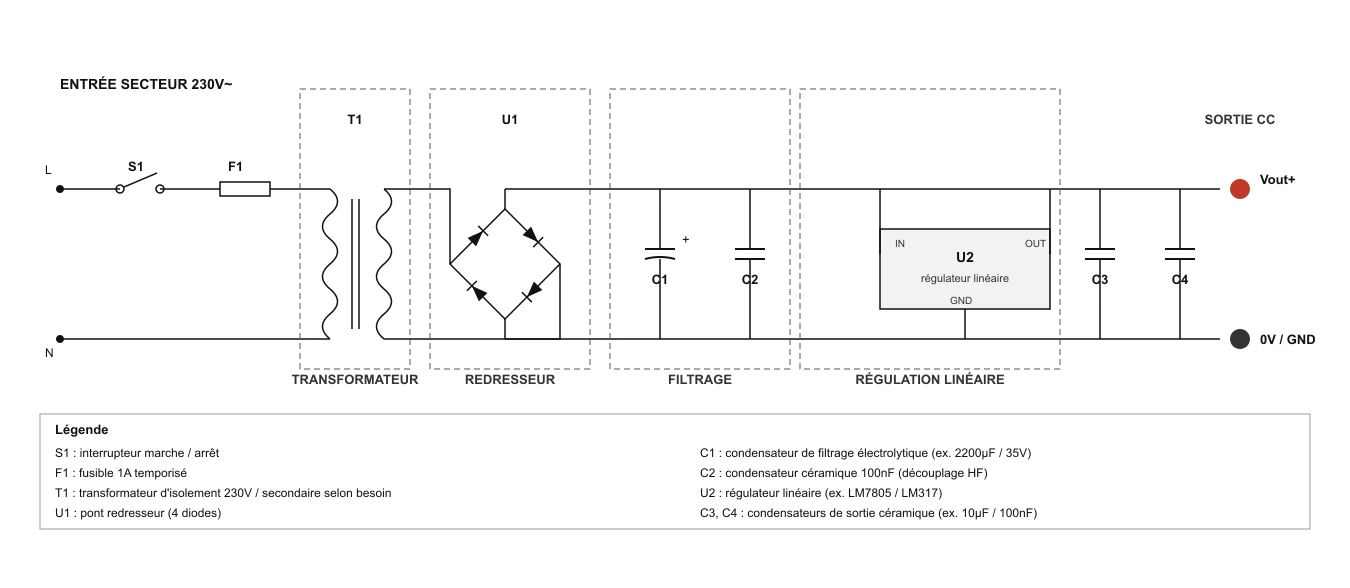
Industrial linear power supplies (also called series regulated linear power supplies) are presented in the form of high-reliability mini-modules powered by the mains, with maximum thermal dissipation homogenized by epoxy molding.
- Encapsulated, the series regulated linear power supply becomes a simple, compact, tropicalized, isolated component, insensitive to humidity, dust, and vibrations.
- 90 basic models, Mono, Double, Triple sources, with fixed or adjustable voltage, provide 3 to 48V (0 to 500V on request), from 0.6W to 24W.
- 29 common options multiply the possibilities of these power supplies.
- In standard version, the housings are equipped with 2 M3 inserts and 1mm pins for mounting on printed circuit boards.
- Other versions are available on request, please consult us.
Input voltage : | 230 VAC ±10% / 50 to 400 Hz |
Output voltage : |
|
Series regulation : |
|
Response time : | < 30 µs |
Residual ripple : | < 1 % of the nominal output voltage (< 0.1 % in fully linear technology) |
Dielectric strength input/output: | 2000 V rms at 5 mA |
Isolation input/output: | 100 Mohms at 500 V |
Output current: | Built-in adjustment (10-turn shaft) on the "1 SR" series with a perfectly rectangular characteristic, from zero to nominal i, with the voltage also adjustable from > 1 V to the nominal voltage |
Protections: |
|
Thermal characteristics: |
|
Mountings: | Different enclosures available:
|