
How does it work?
The output voltage does not result from a direct transformation, but from the energy balance imposed by the duty cycle, the load, and the control loop. This approach allows for high efficiencies by minimizing losses due to dissipation, while ensuring a stable voltage despite variations in load or input voltage.
The most common topologies include non-isolated converters such as buck (step-down), boost (step-up), and buck-boost architectures (SEQIP, Ćuk) for variable input voltages, as well as isolated converters like flyback, forward, or half-bridge/full-bridge structures for higher power levels and safety constraints. Depending on the application, the choice of topology allows for the optimization of efficiency, complexity, isolation, and power capacity.
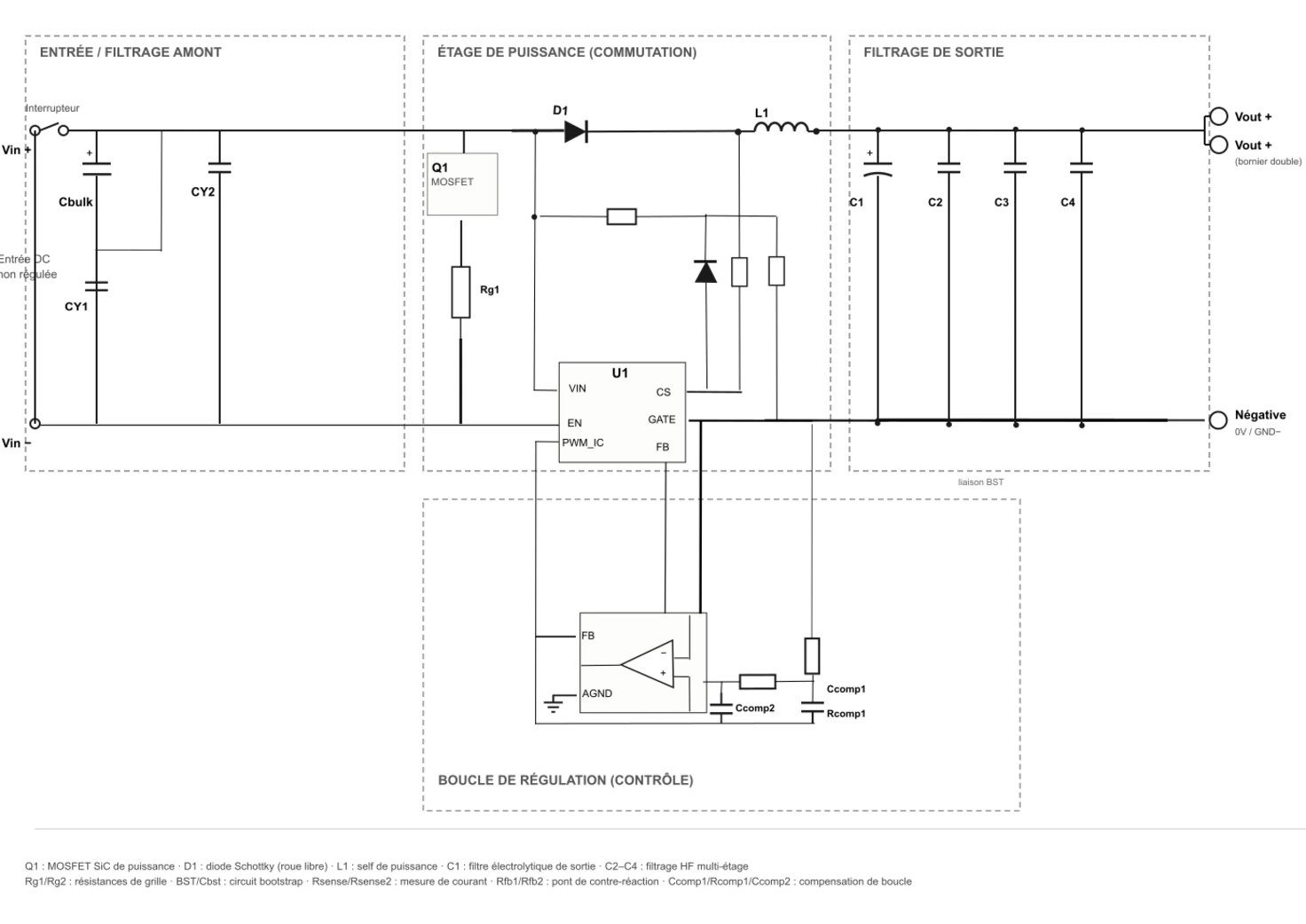
Principle diagram of a DC/DC converter
Our range
We offer a wide range of DC-DC converters standard, covering input and output voltages of 5 to 48 VDC, for power ranging from 1.8 to 1000 W.
In addition, we are able to adapt our converters to your specific needs, offering custom input and/or output voltages, as well as powers up to 2000 W.
These specific versions are based on the same architecture and design principles as our standard range, ensuring identical performance and reliability.
Designed to be insensitive to humidity, dust, shocks, and vibrations, our converters are particularly suited for constrained environments and critical applications, especially in the sectors
Naval
Railway
Embedded systems
Electric vehicles
Demanding industrial applications
Military
Our products
Reference | Power | Input | Output | Technical sheet |
ELCC1 | 1.8 W | 5 - 48 V | 5 - 30 V | |
ELCC2 | 3.6 W | 5 - 48 V | 5 - 48 V | |
ELCC3 | 7.2 W | 5 - 48 V | 5 - 30 V | |
ELCC4 | 12 W | 5 - 48 V | 5 - 48 V | |
ELCC5 | 18 W | 5 - 48 V | 5 - 48 V | |
ELCC6 | 24 W | 5 - 48 V | 5 - 48 V | |
ELCC7 | 6 - 10 - 24 W | 80 - 400 V | 5 - 48 V | |
ELCC8 | 30 W | 12 - 48 V | 5 - 48 V | |
ELCC9 | 50 W | 3.3 - 290 V | 5 - 48 V | |
ELCC10 | 80 W | 3 - 290 V | 5 - 48 V | |
ELCC11 | 100 W | 5 - 48 V | 5 - 48 V | |
ELCC12 | 150 W | 6 - 290 V | 5 - 30 V | |
ELCC13 | 300 W | 7 - 290 V | 12 - 48 V | |
ELCC14 | 600 W | 12 - 290 V | 12 - 48 V | |
ELCC15 | 1 - 1.25 kW | 24 - 290 V | 24 - 48 V |